
Author: AiPlot Research Institute
Focus: RWA / In-depth Analysis of Digital Asset Market
In the RWA industry, the market typically focuses on two questions: who issued the asset and what real-world underlying it corresponds to.
However, when a large cryptocurrency trading platform starts to continuously issue a variety of RWAs such as stocks and ETFs, and concentrates them on the same chain, the truly worthwhile question to study becomes the third: Where will these assets be traded, transferred, collateralized, and recombined?
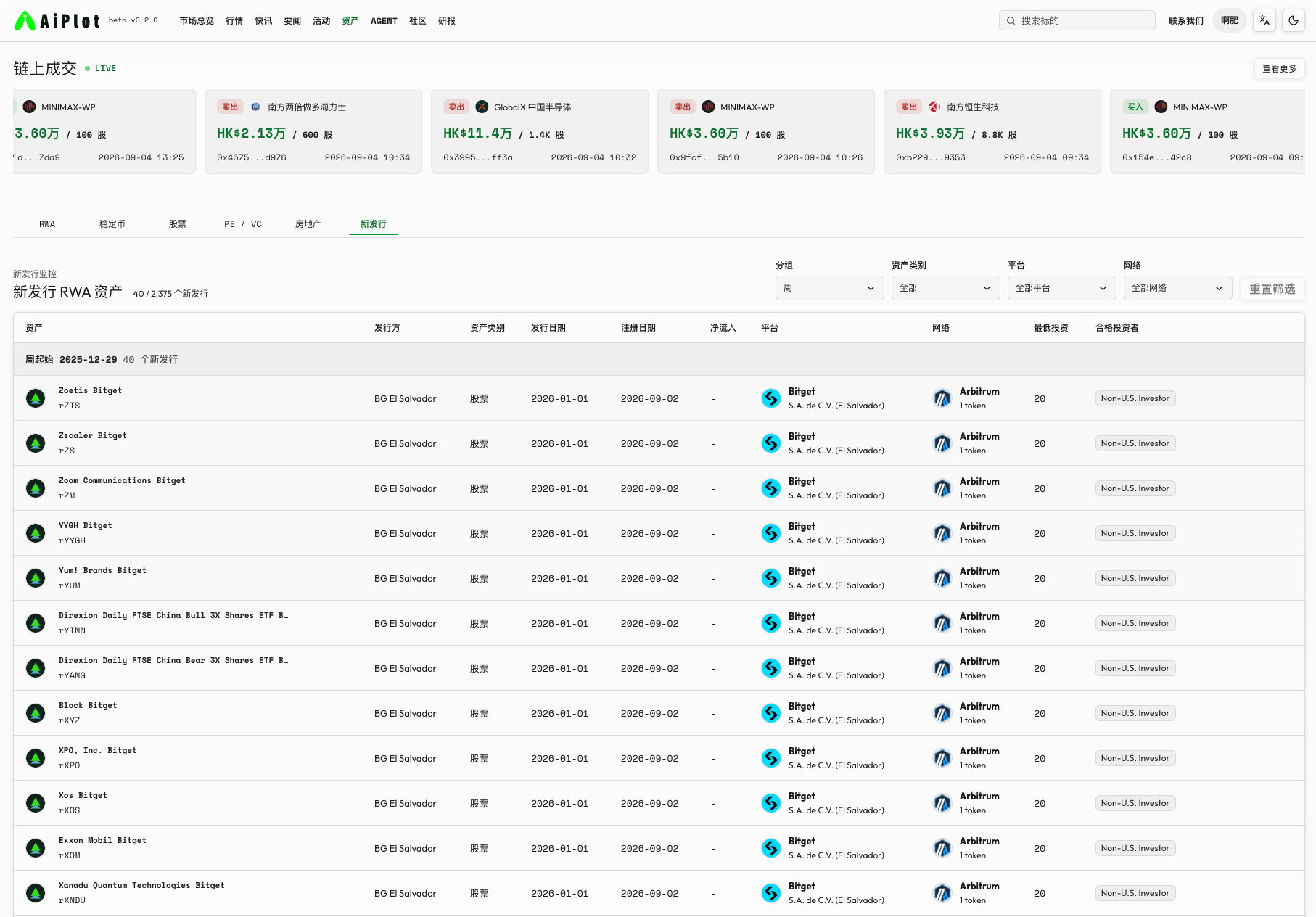
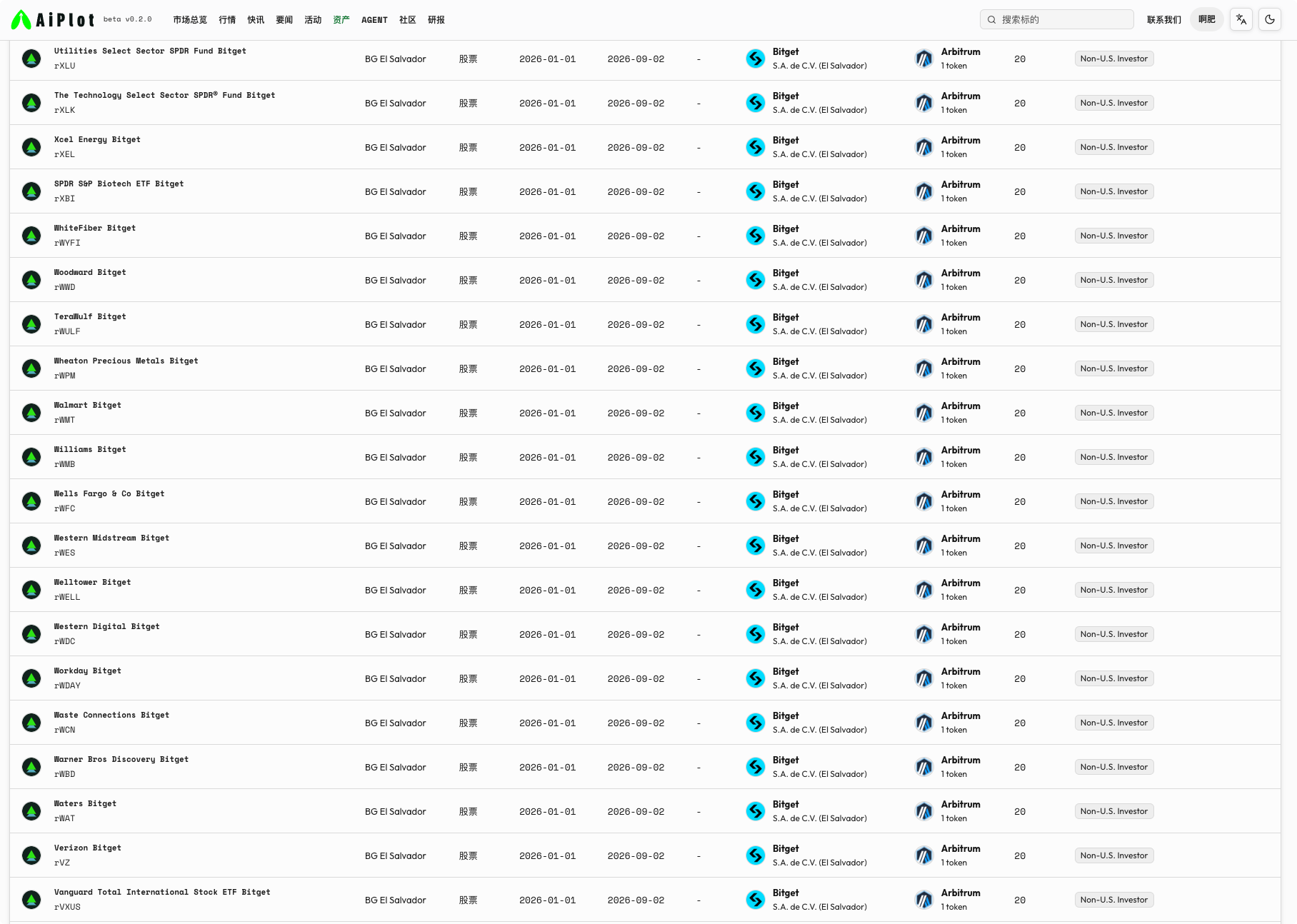
According to AiPlot’s data on “Newly Issued RWA Assets,” Bitget’s related assets prominently appear on the Arbitrum network in the shown weekly data. The assets are not limited to a few popular tech stocks, but cover various categories including pharmaceuticals, finance, energy, mining, retail, semiconductors, ETFs, leveraged ETFs, etc., including Zoetis, Zscaler, Zoom, Yum! Brands, Exxon Mobil, Walmart, Verizon, Western Digital, as well as Direxion Daily FTSE China Bull/Bear 3X ETF, Vanguard Total International Stock ETF, etc. The page also shows that this group has added 40 new monitoring records, with a minimum investment amount of 20, and qualified investors marked as Non-U.S. Investors.
The signal released by this data is more significant than “Bitget has launched another batch of stock tokens”: Bitget seems to be treating Arbitrum as a unified distribution layer for RWA assets, trying to convert real-world assets from a single trading product into a foundational asset that can enter wallets, trading markets, and on-chain financial protocols.
The core judgment of this article is: Bitget's choice of Arbitrum is not just because of low gas fees, but because Arbitrum simultaneously meets the four conditions required for the scaled issuance of RWA assets—security and compatibility of the Ethereum ecosystem, mature DeFi liquidity, a stablecoin settlement environment, and low costs suitable for high-frequency user operations.
This is a commendable choice.
1. What Bitget is doing now is not a single RWA product, but an expansion of asset supply.
Early RWA projects usually start with a single asset or fund, such as tokenized government bonds, money market funds, or a single stock. Their difficulty lies in proving that a single product can achieve issuance, custody, valuation, redemption, and compliant distribution.
Bitget has taken another path: first establishing a larger scale of asset supply, and then integrating more real-world underlying assets into the same trading and account system.
From AiPlot data, the newly issued assets associated with Bitget have already covered multiple industries and product types. In addition to individual company stocks, there are ETFs, leveraged ETFs, and cross-regional assets. This indicates that it is not satisfied with providing a few familiar US stock tokens, but is attempting to build a chain version that is closer to a traditional brokerage’s “asset shelf.”
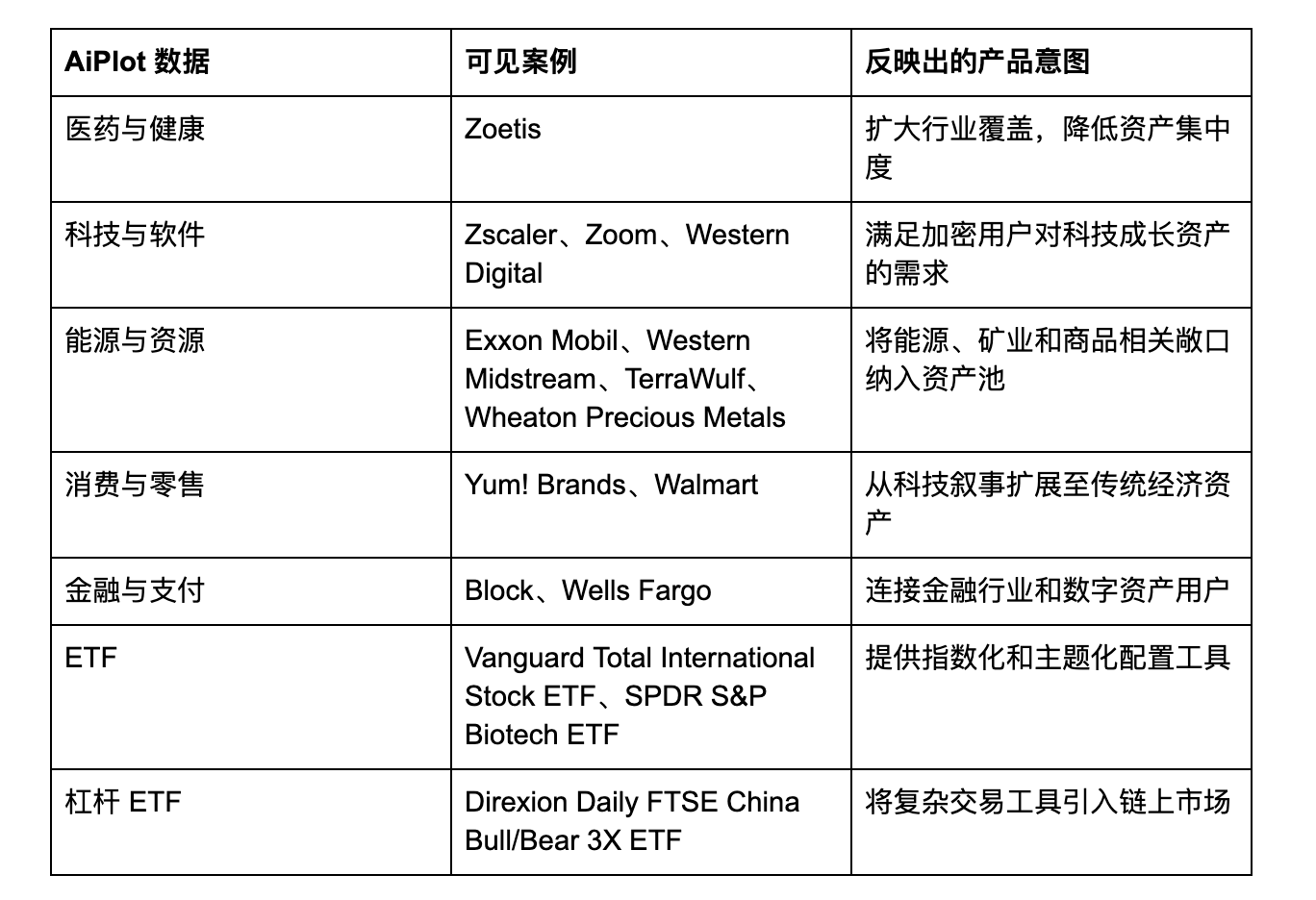
The significance of such asset expansion is that RWA is no longer just a “single product logic” but is beginning to approach a complete financial product catalog. Users can build portfolios around different countries, industries, styles, and risk levels, while the platform has the opportunity to further develop trading, lending, collateral, indices, and yield strategies.
In other words, what Bitget is doing is not simply packaging traditional financial products into tokens, but constructing a sustainable on-chain distribution system that increases the variety of assets.
2. Why is Arbitrum a very suitable choice?
1. It connects Ethereum security with low-cost execution.
RWA users and issuers are usually reluctant to deploy long-term on a completely isolated network that lacks asset and developer bases. Real assets involve multiple aspects including issuance, custody, oracles, trading, clearing, and compliance, making the security, toolchain, and ecological maturity of the network very important.
Arbitrum’s advantage lies in its foundation on Ethereum ecosystem compatibility, while simultaneously lowering transaction costs and increasing throughput and execution efficiency through its Layer 2 architecture. Arbitrum positions itself as a finance-native blockchain platform focused on finance, asset tokenization, and dedicated chain environments, emphasizing Ethereum security, low cost, scalability, and financial application ecology.
For Bitget, this combination is very suitable for RWA: issuers can access Ethereum’s toolchain and developer ecology, users do not have to bear the high costs of every transaction, authorization, and interaction on Ethereum’s mainnet, and on-chain applications can quickly deploy around standardized assets.
The core users of RWA may not necessarily trade frequently every day, but the scaled financial use of RWA certainly requires high-frequency interactions. For example, users may need to transfer stock tokens into wallets, authorize them to trading pools, use them as collateral for loans, adjust margins, or switch between different strategies. If each operation incurs high costs, the on-chain composability of assets becomes difficult to realize.
Thus, Arbitrum's low cost is not just a superficial advantage, but a fundamental condition that determines whether RWA can transition from “holding assets” to “using assets.”
2. Arbitrum already has the liquidity environment required for financial applications.
Which chain an asset is deployed on ultimately boils down to the liquidity issue.
If after the issuance of RWA there are no trading markets, stablecoins, lending protocols, and market-making infrastructure, then even if it completes an on-chain issuance, it may just be a digital certificate lacking practical use cases. The important value of Arbitrum lies in its relatively mature DeFi ecology and stablecoin trading environment.
The Arbitrum official ecosystem page lists financial infrastructures and applications such as Uniswap, Aave, Pendle, GMX, Morpho, USDC, USDT0, etc.2 These protocols cover core modules such as spot trading, lending, yield splitting, perpetual contracts, and stablecoins.
This provides an opportunity for Bitget’s RWA assets to gain an “ecological externality”: even if the on-chain trading volume of a specific stock token is still small, it can integrate with existing trading, lending, and strategy infrastructures in the future without needing to build a complete financial market from scratch.
For RWA, being deployed in a mature financial ecology is often more important than simply choosing a chain with theoretically higher performance but fewer assets and users. What assets truly require is accessible liquidity, not just faster block confirmations.
3. Arbitrum aligns naturally with stablecoin settlements.
Bitget’s rToken product logic is aimed at crypto-native users and uses stablecoins such as USDT as trading and settlement mediums. Users do not need to first open traditional bank accounts, exchange currencies, or transfer funds to independent brokerage accounts but can gain economic exposure to stocks and ETFs in a familiar cryptocurrency environment.
The key to this model is not “stocks becoming USDT,” but rather USDT becoming the settlement layer for real assets entering the on-chain market.
Arbitrum already possesses a rich set of stablecoins and DeFi infrastructure, allowing RWA assets to be traded and combined in a relatively familiar digital dollar environment. For crypto users, purchasing stock-like assets with stablecoins is more aligned with existing habits than transferring funds between different banks, brokerages, and fiat systems.
For Bitget, Arbitrum also aids in forming a unified cash flow cycle: users hold stablecoins in exchanges or wallets to purchase rTokens; rTokens can enter Bitget accounts, trading markets, or on-chain protocols; the generated income, dividends, or sale proceeds go back to the stablecoin balance.
This is a financial closed loop starting from stablecoins, with RWA as the asset side and trading and DeFi as the application side.
4. Arbitrum’s developer and protocol ecosystem is suitable for hosting complex financial products.
Stock tokens are merely the asset layer. To create real financial value from assets, it is necessary to build indices, lending, market making, derivatives, asset management, and automated strategies around them.
Arbitrum's development environment is compatible with Ethereum, reducing the costs for Solidity developers and the migration of existing DeFi protocols. For a platform like Bitget, this means that in the future it can more easily connect with external protocols, wallets, oracles, and asset management tools.
More importantly, what RWA needs is not a single "trading function," but a suite of application modules. A stock token can be traded, but if it cannot be collateralized, its capital efficiency is limited; it can be collateralized, but if there is no reliable price information, the liquidation mechanism is hard to operate; there may be price information, but without sufficient stablecoin liquidity, the market cannot expand.
The existing financial application environment in Arbitrum provides a more realistic starting point for the continued combination of these modules.
3. Bitget's Advantage: It Handles Asset Supply and User Distribution Simultaneously.
One of the biggest bottlenecks in the RWA industry is not the issuance technology, but the distribution of assets.
Traditional financial institutions can provide quality assets but may not have crypto users; native DeFi protocols have on-chain users but may not connect with compliant securities or real custody. Bitget's unique position lies in its simultaneous ownership of a trading platform, crypto users, stablecoin liquidity, account systems, and content distribution capabilities.
Gracy Chen emphasized in related content that the value of Reality is not merely to wrap traditional brokerages in a crypto shell but to allow rTokens to enter the crypto-native scenario: assets can be transferred to personal wallets, used in supporting DeFi protocols, or connected with Bitget's Unified Account for scenarios like grid trading, copy trading, and Bitget Earn.
This is also one of the deeper reasons for Bitget's choice of Arbitrum: Arbitrum is not just a place for issuance, but also a public execution environment for Bitget to distribute assets to on-chain users.
If assets remain solely in Bitget's centralized accounts, they are closer to a digital entry point for a TradFi product; if assets can enter wallets, DEXs, lending protocols, and other applications, they truly possess the on-chain attributes of RWA.
Bitget's advantage lies in its ability to connect these two distribution modalities: one end is exchange-level user experience and liquidity, and the other end is the open combination of public chain wallets and DeFi protocols.
4. What Changes Are Happening in Bitget's Asset Supply Strategy According to AiPlot Data?
The asset list in AiPlot's data has an easily overlooked feature: it is not just حول the most popular US tech stocks, but is beginning to cover a broader range of industries, regions, and product structures.
This indicates that Bitget's RWA strategy is potentially shifting from “providing a few popular assets” to “building a diversified asset shelf.” The more complete the asset shelf, the more likely the platform can meet the configuration needs of different users and further produce composite products.
For instance, users can place tech stocks, energy stocks, healthcare stocks, and international ETFs within the same on-chain account; protocols can build indices or baskets around these assets; lending markets can set collateral ratios for different assets; strategy products can adjust automatically according to volatility, industry, and market time zones.
From the long-term development of RWA, this kind of asset expansion is more noteworthy than the short-term hype of a single asset. Because the value of financial infrastructure usually stems from the diversity of assets: the more assets there are, the greater the portfolio space; the greater the portfolio space, the richer the possibilities for trading, lending, and asset management.
Of course, the newly issued numbers on the AiPlot page represent dynamic data and cannot be simply equated with each asset having equal scale of real liquidity. Researchers still need to continue observing each asset's issuance structure, number of holders, transfer volume, cross-chain distribution, trading venues, and DeFi usage.
But from the supply side, Bitget has already demonstrated strong intentions for asset expansion.
5. Bitget's Choice of Arbitrum Essentially Represents a Choice of “Common Underlying for Financial Applications.”
From a technical perspective, Bitget can choose multiple blockchains to issue RWAs. The problem is not which chain is absolutely the best, but which one is most suitable for the current product objectives.
For Bitget, current products have several clear requirements: they need to be compatible with crypto user habits, require stablecoin settlements, need lower operational costs, need to connect to DeFi, need to support scaled asset supply, and also need assets to be usable by wallets and external protocols.
Arbitrum strikes a good balance among these conditions.
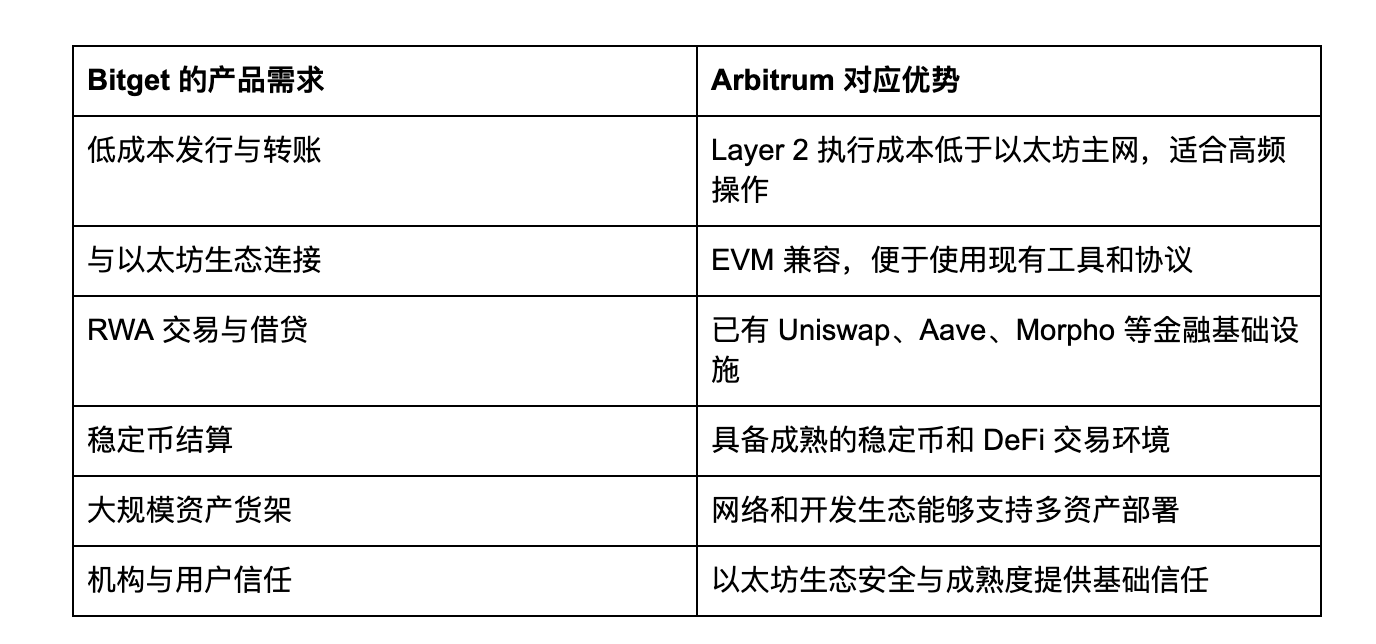
Therefore, Bitget's choice is commendable. It is not chasing the short-term narrative of any particular chain, but is selecting a network capable of simultaneously hosting asset issuance, trading, clearing, and application combinations around the real use needs of RWA.
This represents a relatively pragmatic judgment on infrastructure.
6. The Next Stage of RWA: From "Buying Stocks" to "Using Stocks."
If RWA only allows users to buy a stock token with USDT, its value mainly lies in convenience of access and improved trading experience; if stock tokens can further be collateralized, lent, market made, and combined, it starts to reflect the financial innovation value of blockchain.
Bitget's product design has clearly pointed toward this latter direction.
According to public information, the design objectives of Bitget rTokens include using USDT to gain economic exposure to US stocks and ETFs, connecting unified accounts, margin, lending, grid trading, copy trading, and certain yield products. Gracy Chen has also emphasized that rTokens can enter personal wallets and supported DeFi protocols.
This means that Bitget hopes to turn stocks from a position in a closed account into assets that can be leveraged by on-chain funds and strategies.
Potential product forms in the future may include:
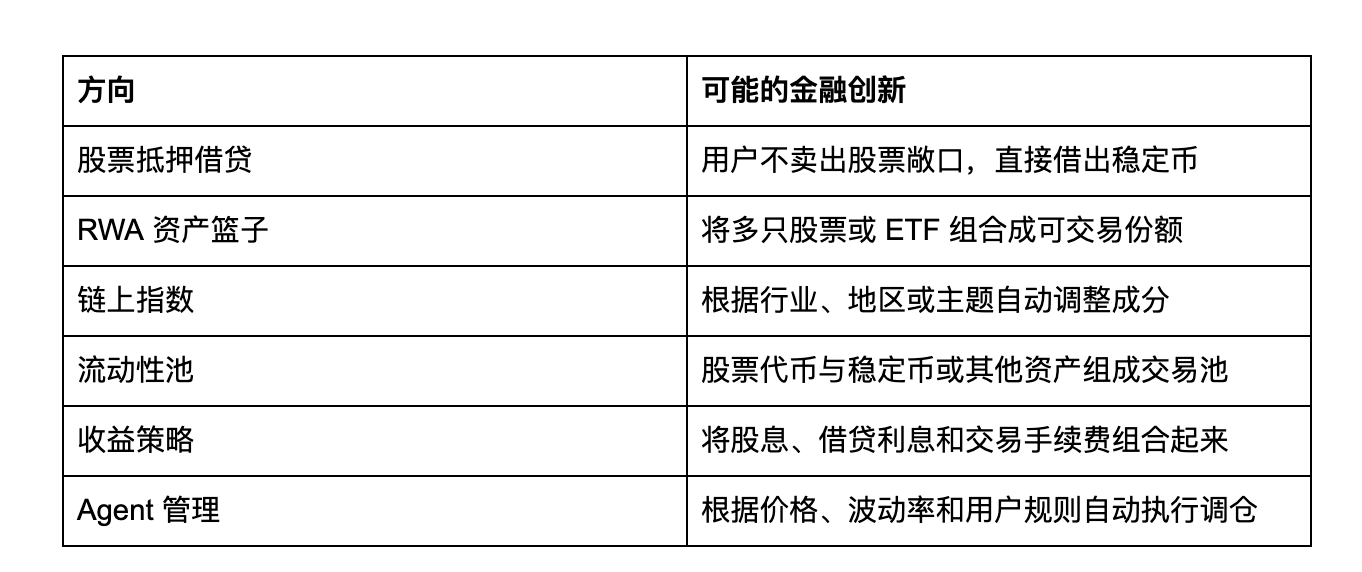
This is also why RWA needs a public chain rather than just a trading page. Exchanges can provide buy and sell functionalities, but public chains allow assets to be recognized, invoked, and combined by more external programs.
7. It's Important to Distinguish: The Innovative Value of RWA Does Not Equal the Disappearance of Product Risks.
Acknowledging Bitget's choice does not mean overlooking the structural differences of RWA products themselves.
First, tokenized stocks do not necessarily equate to directly holding stocks. Different products may provide economic exposure, tokenized debt securities, derivative contracts, or other legal structures; whether investors have shareholder rights, dividend rights, redemption rights, and transfer rights needs to be checked in the specific product documents.
Secondly, deploying on Arbitrum does not mean assets automatically gain liquidity. The chain’s infrastructure can only provide possibilities; real liquidity still depends on issuance scale, market-making arrangements, user demand, and available trading markets.
Furthermore, while multi-chain deployment may expand user coverage, it can also lead to liquidity fragmentation, price discrepancies, and increased cross-chain operational complexity. Therefore, Bitget concentrating a batch of assets on Arbitrum actually carries a certain advantage: it helps form a unified asset catalog, a unified settlement environment, and more concentrated liquidity.
Finally, the "Non-U.S. Investor" label in AiPlot indicates that relevant products have geographic and investor qualification restrictions. The global distribution of RWA does not equal unconditional openness; the scope of compliant investors, custody structures, redemption mechanisms, and underlying asset support remain core variables for assessing product quality.
These boundaries do not diminish Bitget's strategic value; rather, they highlight its true challenge: how to long-term integrate large-scale asset supply, on-chain liquidity, and compliant product structures.
8. Conclusion: Bitget's Choice of Arbitrum is Choosing a “Usable” Chain for RWA.
Bitget's concentrated issuance of multiple types of RWA assets on Arbitrum is worthy of positive evaluation from a strategic perspective.
Its choice has clear logical consistency: Bitget possesses crypto-native users and stablecoin flow, Reality provides real asset issuance and support structures, Arbitrum offers low costs, Ethereum compatibility, and a mature DeFi environment, while AiPlot can help the market observe the on-chain performance of these assets post-issuance.
The combination of these four links forms a clear closed loop for RWA:
Real Asset Supply → Tokenized Issuance → Arbitrum Deployment → USDT Settlement → Wallets and Trading → Lending, Collateral, and Strategy Combinations.
From this perspective, Bitget is not merely “issuing a few more assets” on Arbitrum but is attempting to make Arbitrum a high-speed highway for the distribution of real assets.
Its choice of Arbitrum is particularly commendable in not treating the public chain as a marketing label but recognizing several foundational conditions truly needed by RWA: low operational costs, stable settlement assets, mature financial protocols, Ethereum ecosystem compatibility, and a sufficiently large network of developers and users.
In the future, competition for RWA may no longer just be a contest among issuers but a systemic competition of “asset supply + distribution gateways + on-chain liquidity + application ecology.” Whoever can efficiently bring more real assets on-chain and ensure that they are truly traded, collateralized, and combined after issuance is more likely to become an important participant in the next generation of digital financial infrastructure.
What Bitget is currently doing is a crucial step in this competition.
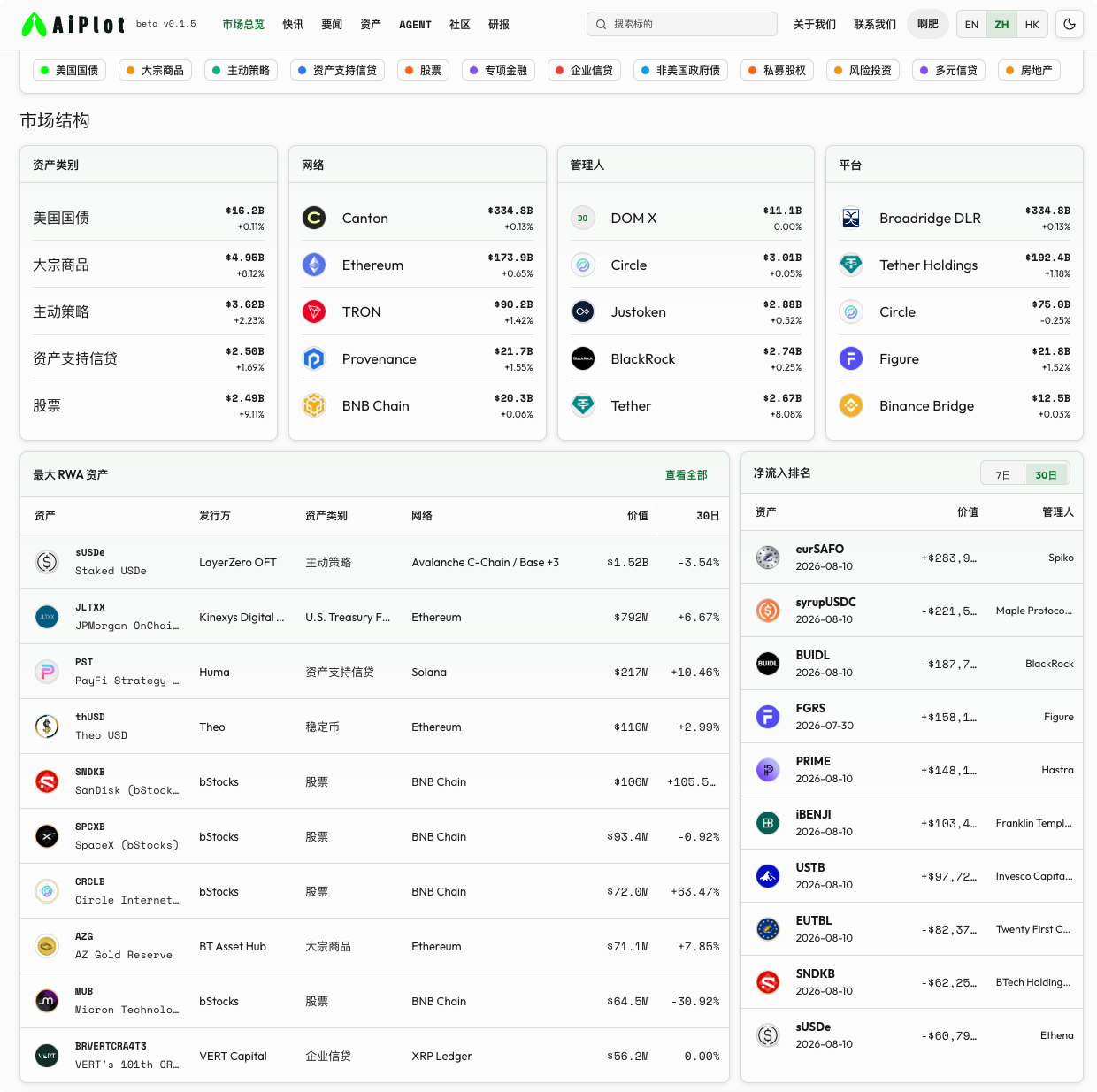
For more data and analysis, please follow Aiplot:
📖 Community Interaction:
Telegram:
https://t.me/+IIYMcJigBAo4Mjg1
The content of this article represents only the author's personal views and does not represent the position of this platform. The opinions, conclusions, and suggestions in this article are for investor reference only and do not constitute any investment advice related to this platform. The market carries risks, and investment should be cautious.
Disclaimer: This article represents only the personal views of the author and does not represent the position and views of this platform. This article is for information sharing only and does not constitute any investment advice to anyone. Any disputes between users and authors are unrelated to this platform. If the articles or images on the webpage involve infringement, please provide relevant proof of rights and identity documents and send an email to support@aicoin.com. The relevant staff of this platform will conduct an investigation.