
Author: Wall Street Insight
Barclays believes that the August non-farm employment data is strong but contains exaggerated elements, and the probability of a rate hike in September has marginally increased.
Wall Street Insight mentioned, on September 4, the U.S. Bureau of Labor Statistics released data showing that non-farm employment increased by 162,000 in August, far exceeding Barclays' forecast of 25,000 and the market consensus expectation of 55,000. The data for the previous two months was revised upward by a total of 55,000, with the July reading adjusted from a previous -23,000 to +21,000.
According to the trading desk, after the employment data was released, Barclays Bank's Marc Giannoni team published a research report, stating that part of the strong growth stems from a seasonal rebound in the leisure and hospitality industry and local education employment, and does not reflect a sustained improvement in labor demand; this month's data exaggerates the actual strength of the labor market to some extent.
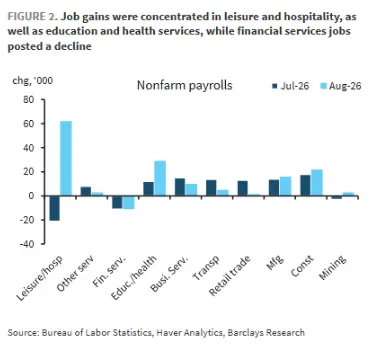 (Employment growth is primarily concentrated in the leisure and hospitality sector, as well as in education and healthcare services, while jobs in the financial services industry have decreased)
Barclays maintains its benchmark forecast of a 25 basis point rate hike in September and points out that the inflation data to be released next week will be a key variable.
Although the bank expects the month-on-month core CPI and core PCE for August to be around 0.23%, given that Fed Chair Waller emphasized the need to maintain "sufficient and sufficiently rapid" confidence in bringing inflation back to target, Barclays believes that a moderate inflation reading is not sufficient to rule out the possibility of a rate hike in September.
Employment growth exceeds expectations, but statistical factors significantly distort
The August non-farm payrolls added 162,000 jobs, higher than Barclays' forecast of 25,000 and substantially exceeding the market consensus expectation of 55,000. The three-month average growth rate rose to 71,000 jobs per month, still above Barclays' estimated "breakeven" growth rate (approximately 0).
However, the team believes this growth has some technical "overstated" elements:
- Leisure and hospitality sector: increased by 62,000 in a single month, having declined for two consecutive months prior, this month represents a technical rebound;
- State and local education employment: rebounded by 42,000 in August, correcting a sharp decline in July (-58,000);
- Government sector: overall contributed 35,000 jobs, with local education departments being the main source.
Private sector employment added 127,000, with the service sector contributing 86,000, manufacturing adding 16,000, construction increasing by 22,000, and mining adding 3,000.
Barclays emphasizes that the three-month average growth rate of private non-farm employment of 75,000 per month is a "cleaner" indicator for measuring potential labor demand, and suggests using this instead of the single month data influenced by noise as a reference benchmark.
Birth-death model adjustments cause statistical bias
Barclays' report points out that August's non-farm data was also affected by the birth-death adjustment methodology.
Compared to the same period in 2025, this year's August birth-death adjustment reduced the drag on employment by approximately 32,000, which to some extent boosted this month's reading.
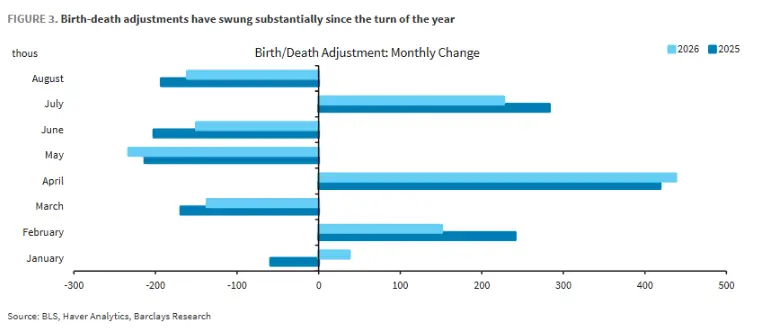 (Since the beginning of the year, there have been significant fluctuations in the birth-death adjustment)
However, looking at the three-month average from June to August, the adjustment for 2025 (-37,000) is roughly comparable to that of 2026 (-28,000), with monthly fluctuations tending to offset each other on the timeline.
Barclays believes that this volatility may stem from methodological adjustments implemented by the BLS since January, which uses existing sample employment information to estimate the employment effect of new businesses. Although the new procedure aims to reduce benchmark revisions, actual monthly impacts are difficult to predict.
Unemployment rate slightly rises, labor supply still fluctuates
The unemployment rate in August slightly increased by 5 basis points, with the precise unrounded value being 4.141% (up from 4.090% in July), but still rounded to 4.1%.
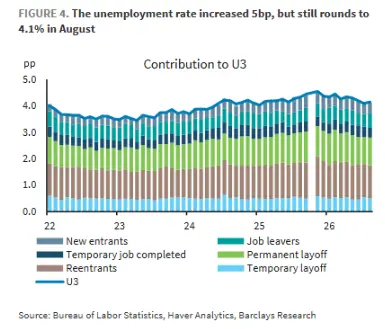 (The unemployment rate increased by 5 basis points in August but remains rounded at 4.1%)
The reason for the rising unemployment rate is: although household survey employment increased by 569,000, the labor force expanded by 683,000, a larger increase.
The labor participation rate rose by 0.2 percentage points to 61.6%, mainly driven by a significant jump of 0.8 percentage points in the participation rate of the 16 to 24 age group, with the group aged 55 and above also contributing a 0.3 percentage point increase.
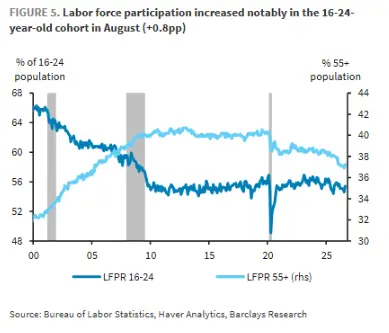 (In August, the labor participation rate in the 16-24 age group significantly rose)
However, the most meaningful golden age labor participation rate (ages 25 to 54) remains unchanged at 83.4%.
Barclays' analysis further points out that the approximately 0.2 percentage point decline in participation since May primarily stems from a reduction in participation willingness across all age groups, rather than due to an aging population structure.
This phenomenon is highly consistent with the narrative of labor supply pressure brought by tightened mobility restrictions, and is an important basis for the team's judgment that "the breakeven employment growth is limited."
Labor income significantly improves, purchasing power marginally increases
Barclays believes that the employment report brings positive signals on the income side:
- Average hourly earnings (AHE): increased by 0.27% month-on-month, and by 3.3% year-on-year, higher than July's month-on-month increase of 0.16%;
- Average workweek: increased by 0.1 hours to 34.4 hours;
- Private sector wage income: collectively increased by 0.67% month-on-month, the fastest growth since January (0.78%);
- Three-month annualized wage income growth rate: reached 4.7%, higher than the 3.7% as of May this year, indicating positive real income growth after adjusting for inflation.
However, Barclays' wage growth model assigns a lower signal weight to this month's average hourly earnings data, maintaining its judgment of the bottom wage growth rate at 0.26% per month (annualized at 3.1%), which falls within the range of 3.0% to 3.5% that the Fed considers consistent with the 2% inflation target.
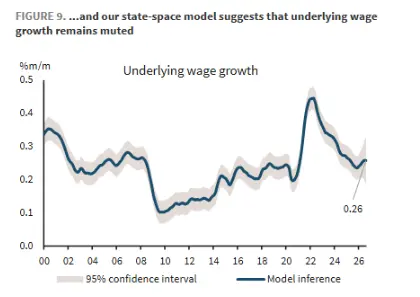 (Barclays model indicates that potential wage growth remains weak)
This estimate takes into account the upward trend in Q2's employment cost index as well as data from the Atlanta Fed's wage growth tracker. The team also points out that the current 4.7% income growth rate is difficult to sustain and expects the growth rate of real consumption expenditure to slow to a seasonally adjusted annual rate of 1.5% in the second half of the year.
The probability of a September rate hike marginally increases, with inflation data as the next key node
Comprehensive analysis suggests that the August employment data marginally strengthens the rationale for a 25 basis point rate hike by the FOMC in September, aligning with Barclays' benchmark expectations.
The rationale for the rate hike is: Employment growth continues to remain above breakeven levels, and improvements in wages and hours support labor income. The only weak point is the mild rise in the unemployment rate, but this seems somewhat disconnect with the strong job creation.
Market focus has now shifted to next week's inflation data. Barclays expects core CPI and core PCE for August to record a month-on-month increase of 0.23%.
Although this reading is generally moderate, given that Fed Chair Waller has repeatedly emphasized the need to establish greater confidence in returning inflation to target "clearly and at a sufficient speed," the team believes that a 0.23% inflation reading is not sufficient to rule out the possibility of a September rate hike.
In summary, for fixed income and rate traders, a September rate hike remains a highly probable baseline scenario, putting pressure on short-term rates; inflation data will be the final key piece of the puzzle this month.
Disclaimer: This article represents only the personal views of the author and does not represent the position and views of this platform. This article is for information sharing only and does not constitute any investment advice to anyone. Any disputes between users and authors are unrelated to this platform. If the articles or images on the webpage involve infringement, please provide relevant proof of rights and identity documents and send an email to support@aicoin.com. The relevant staff of this platform will conduct an investigation.