
The traffic volume in the Strait of Hormuz has plummeted by 80%, and Middle Eastern tanker freight rates have reached an all-time high.
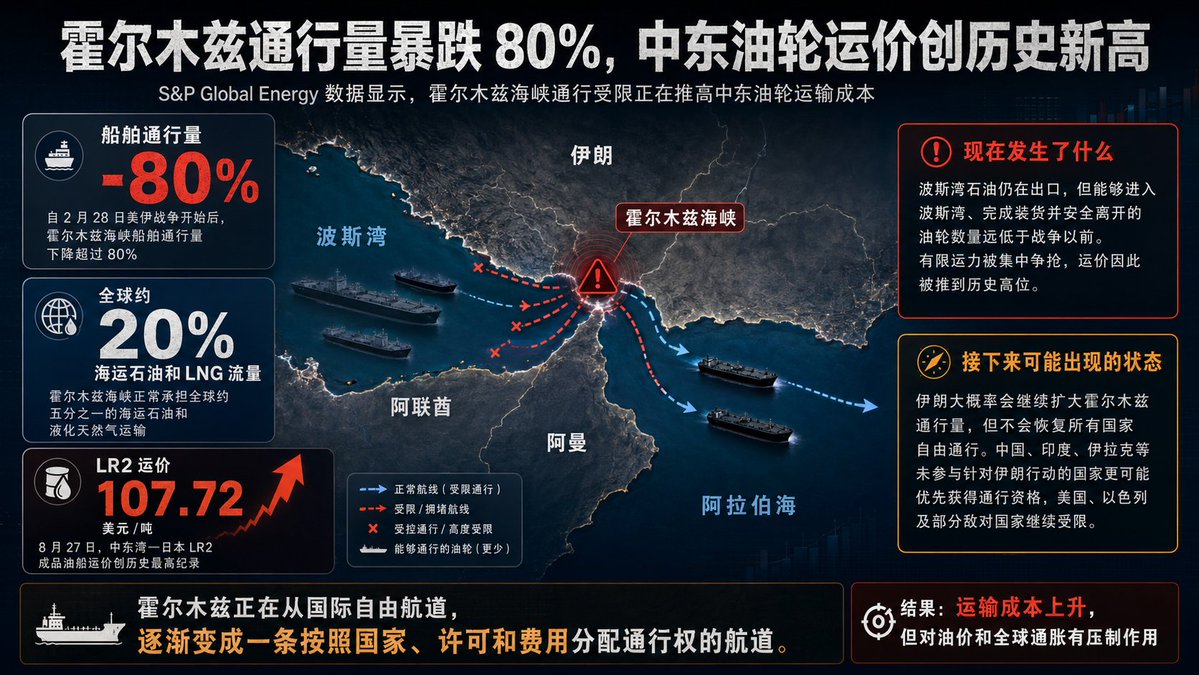
According to the latest data from S&P Global Energy, since the outbreak of the Iran-U.S. war on February 28, the vessel traffic in the Strait of Hormuz has decreased by over 80%, while this region normally handles about 20% of the global maritime oil and liquefied natural gas flow.
With fewer vessels, there are even fewer ships able to enter the Persian Gulf to load cargo, which naturally drives up freight rates. On August 27, the freight rate for LR2 oil tankers from the Middle East Gulf to Japan has already risen to $107.72 per ton, setting a new historical high.
At present, the Persian Gulf can still continue to export oil, but the number of vessels transporting this oil is clearly insufficient. Iran is currently using special permits and selective releases, and the number of tankers that can enter the Persian Gulf, complete loading, and safely leave is far lower than before the war, so the limited transport capacity is being fiercely contested, which is directly reflected in the freight rates.
This also makes me more inclined towards the previous judgment that Iran will likely continue to expand traffic in the Strait of Hormuz but will not restore free passage for all countries.
Countries such as China, India, Iraq, and others that have not participated in actions against Iran will gradually obtain more passage qualifications, while the U.S., Israel, and some hostile countries will continue to be restricted. This way, Iran neither needs to completely close the Strait of Hormuz nor stops controlling the export direction of oil from the Persian Gulf.
If we finally add in the charging mechanism that Iran and Oman are currently discussing, the Strait of Hormuz will likely gradually transform from an international free navigation lane into a route for passage rights allocated according to countries, permits, and fees.
Although this is not something to be pleased about, it can indeed reduce oil prices and lower global inflation.
@Gate Crypto, U.S. stocks, Hong Kong stocks, Korean stocks, gold, CFD, one-stop trading for prediction markets
Disclaimer: This article represents only the personal views of the author and does not represent the position and views of this platform. This article is for information sharing only and does not constitute any investment advice to anyone. Any disputes between users and authors are unrelated to this platform. If the articles or images on the webpage involve infringement, please provide relevant proof of rights and identity documents and send an email to support@aicoin.com. The relevant staff of this platform will conduct an investigation.