

Source: "The Chopping Block"
Organizer: Felix, PANews
Broadcast date: September 3
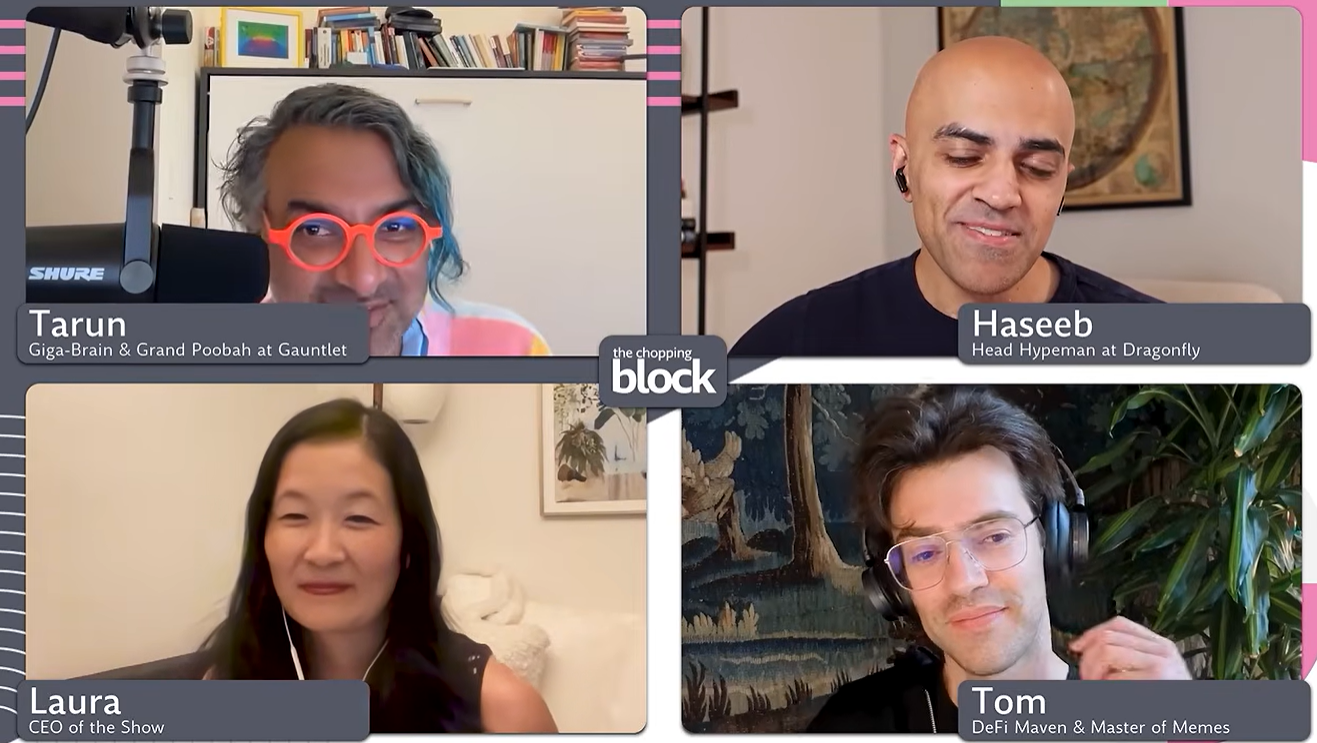
Recently, Laura Shin, founder of Unchained, along with Haseeb Qureshi, Managing Partner at Dragonfly, Tom Schmidt, General Partner, and Tarun Chitra, Managing Partner at Robot Ventures, analyzed the explosive trend of "U.S. stock tokenization + Meme coins" on the Robinhood Chain, the competitive landscape of Solana, and the compliance game that Hyperliquid is attempting to enter in the U.S. compliance market on the podcast "The Chopping Block".
During the discussion, the guests had different opinions on the cultural phenomenon of retail investors seeking "entertainment value" in high-risk trading. Some viewed it as mere capital destruction, while others regarded it as an emerging token distribution model. Additionally, rumors about Hyperliquid trying to enter the U.S. compliance market through a partnership with Payword, a subsidiary of Kraken, were mentioned.
PANews has compiled the highlights of the discussion.
Haseeb: The hottest narrative this week is undoubtedly the rise of the Robinhood Chain. When the Robinhood Chain was initially launched, trading volumes surged and then fell back, leading many to think it might just be a flash in the pan. But now, the Robinhood Chain is experiencing a second wave of explosion, with active wallets exceeding 125,000, daily transactions reaching 5.7 million, DEX daily trading volume surpassing $1.2 billion, and daily blockchain transaction fee revenue reaching $2 million.
This round of explosion is largely driven by on-chain tokenized stocks and Meme coins. This has also driven a surge in Arbitrum, as the Robinhood Chain is built on the Arbitrum Stack, with a significant portion of the fees generated by the Robinhood Chain being returned to Arbitrum and Robinhood. Meanwhile, Ethereum also received a tiny bit of data availability (DA) fees, but very little. This has led many to debate: Does this prove that L1 cannot capture value from the prosperity of L2 above it? Is this a bearish signal for L1?
Tom: I am quite surprised. This is a "company chain," yet it generates such astonishing on-chain activity. What’s more interesting is that about half of the trading volume comes from tokenized stocks, not just Meme coins. I am very curious about the internal reactions of the Robinhood team right now. I dare say that when they initially planned this chain, the beautiful blueprint in their minds was: "We are going to create a completely new financial system, 24/7 stock trading, a global, permissionless open mainnet..."
And now? Everyone is wildly trading various vulgar Meme coins. However, there is indeed a very real aspect of humanity involved in that. Tarun, as the "Robinhood Chain spokesperson," what do you think?
Tarun: I wouldn’t dare to call myself the Robinhood Chain spokesperson. But I must say, it feels exhilarating to see "M forks" (Ohm fork projects) making a comeback in 2026.
For those who are unaware, let me explain: Ohm (OlympusDAO) was a very famous stablecoin experiment on Ethereum in 2022, bearing a hint of a Ponzi scheme, which gave rise to the (3,3) meme and ultimately collapsed in 2022. Although its original protocol survived, it is far from what it once was.
Now the people on the Robinhood Chain have cleverly applied the "Ohm fork mechanism" to Meme coins. In simple terms, these Ohm forks are now utilizing Meme coins in an extremely creative manner. These contracts are not mere copies; they have undergone enough modifications, and you can think of them as a kind of "Meme coin launch platform." To launch a Meme coin, you have to bind it, and the asset you pair with it is the underlying tokenized stock.
The logic is: to mint this Meme coin, you basically have to buy the tokenized stock and lock part of it in a liquidity pool. For example, if you use $100 worth of stock to mint, you will receive $10 worth of Meme coins, which will be locked in liquidity provision, and the remaining $90 will be returned to you. The locked $10 is to provide liquidity, just like the classic bonding curve mechanism.
But what's really interesting is that this stock pairing effectively turns Meme coins into "token incentives" for a particular stock. Recalling the Ohm example, at that time there were Ohm, locked Ohm, and ETH, with ETH acting like that stock, and everything revolved around it. Locked Ohm was used to provide liquidity to ensure you could convert to ETH, while Ohm was the incentive itself.
The classic case is the wildly popular Meme coin "BONER." The BONER token is paired with the tokenized stock of HIMS. HIMS is an online urology medication retailer that has been heavily advertised in New York City. The BONER coin has essentially become the "liquidity incentive" to mint HIMS stock tokens.
Haseeb: Over the weekend, retail investors went wild trading BONER coins. The explosive rise of Meme coins caused the price of HIMS tokenized stock on DEX to significantly overshoot, far exceeding the closing price of U.S. stocks from the previous Friday. Many retail investors, driven by FOMO, frantically bought into Robinhood Chain or FOMO aggregators, believing that this Meme coin would continue to rise.
However, by Monday morning when U.S. stocks opened, with arbitrage channels opened, anyone could mint new HIMS stock to bring onto the chain. Those retail investors who bought BONER and overpriced HIMS coins at high positions on Sunday night were ruthlessly wiped out by hedge funds and arbitrage traders on Monday morning, with their accounts instantly zeroed out.
Retail investors cheered for the rise of the Meme coins, but in reality, every time they pushed the price of the Meme coins up on weekends, they were handing over real money to Wall Street hedge funds through this huge "decoupling." This group even celebrates this behavior, which is just insane.
Tarun: I feel this is somewhat similar to the DeFi Summer meeting the GameStop retail frenzy, mixed with 4chan culture (note: a unique internet subculture originating from the well-known anonymous imageboard forum 4chan, characterized by a highly deconstructive, anonymous, anti-establishment, and meme-filled nature) and tokenized stocks. To some extent, this is "investing in fools."
Tom: There is indeed a peculiar "generational culture" and entertainment value here: "Haha, look how much money we can lose!"
Haseeb: But this is just so stupid. At least GameStop had a theory, saying we are going to beat Wall Street by collectively shorting and saving the company. But the mathematical logic here is completely off. The capital involved in these on-chain tokenized stocks is negligible compared to the real stocks underlying U.S. stocks; you can't short anyone at all. If you were to ask your AI: "Hey, can I short Wall Street by buying a Meme coin? What do you think?" your AI would surely respond: "Are you out of your mind? Hand over your private key; you're barred from trading." This is purely a Meme coin game. There is a new game every cycle, and this time it just has the shell of RWA.
Laura: I agree with Haseeb. This is really bad. While my initial comment was just observational, if I were to make a value judgment, I stand with Haseeb.
After experiencing this bear market, retail investors have basically been completely crushed. They have encountered various crashes and the ruthless exploitation of the Meme coin ecosystem. Many ordinary people have completely exited from cryptocurrency. A few days ago, I invited Jeff Dorman to the show, and we discussed that, from all objective metrics, the underlying construction of the cryptocurrency industry (such as stablecoin adoption, compliance progress, ETFs, etc.) is at its historical best level. But I told him: "It is precisely because the last Meme coin frenzy hurt retail investors so deeply that even if the objective facts are good, market sentiment remains at an all-time low." He couldn’t even understand this perspective at that time.
The retail investors who have lost everything in the trenches do not care at all about "stablecoins being adopted by the mainstream" or "ETFs being approved"; they only know that they've lost everything. Therefore, this mechanism of "designed to ensure retail suffers losses for hedge funds" is something we, as voices in the industry, absolutely should not encourage or whitewash.
Tarun: I understand your moral condemnation. But from an anthropological perspective, this is indeed fascinating. RWA has long been considered the most boring, least token-incentivized, and hardest to promote area within the cryptocurrency industry. Yet this mechanism has successfully inserted a token incentive into RWA, pushing the issuance volume of RWA on the Robinhood Chain up by 50% within a week, reaching $70 million to $80 million.
This indicates that as long as the demand is large enough, it will force out new issuance. Although retail investors may come for the BONER coin, ultimately, the tokenized HIMS stock remains on the chain.
Haseeb: But the difference between a casino and this is that people playing slot machines in a casino know they are consuming and entertaining; they know they are losing money based on mathematical probability. However, retail investors rushing into these Meme coins are deceived by various KOLs and promotional rhetoric on social media; they firmly believe they are making money and can achieve financial freedom through this. This "illusion of being able to make money" is the most deadly and cruel aspect.
Haseeb: The next important topic is whether the Robinhood Chain is now stealing the thunder from Solana?
Trader Flood tweeted, "Solana is in the most dangerous situation since its inception." Some of the arguments presented are: Solana was the first to do tokenized stocks and previously almost monopolized all Meme coins. So, since everyone wants to mix RWA and Meme coins together, why is this happening on the Robinhood Chain instead of Solana?
Additionally, Solana currently lacks any perpetual contract exchanges with substantial market share and has virtually no market share for RWA (which is now occupied by Robinhood and Ethereum). Many mainstream trading pairs on Solana are now gradually turning to pair with stablecoins (like USDC) rather than being tied to SOL. This seems to indicate that while Solana had a first-mover advantage, it is now being strongly usurped by Robinhood, a latecomer.
Many people are fiercely debating on X, arguing whether retail underestimated Solana or if Solana just laid its groundwork too early, resulting in Robinhood becoming the stepping stone for liberating thoughts and testing the waters?
Or, as Tarun said, if the majority of users entered through FOMO, then for retail investors, what underlying chain it is really doesn’t matter. Because the binding and locking effects of the underlying chain have disappeared. What does everyone think? Will this be the death knell for Solana?
Laura: This reminds me of a very interesting piece of gossip: I heard that Robinhood Chain almost chose to build on Solana initially, but at the last minute, they changed their mind and opted for Arbitrum. At that time, there was frequent interaction between the Arbitrum Foundation and the Solana Foundation on Twitter, clearly indicating that both sides were engaged in fierce competition, and later some media disclosed these rumors.
I interviewed AJ on the show at that time. Although he did not directly confirm whether Robinhood was extremely close to choosing Solana, he explained that "when you have your own exclusive L2, the entire economic model changes completely—you are no longer simply paying to the underlying chain; you can even divert and earn (fee sharing)."
So, if Robinhood really chose to build on Solana back then, perhaps Solana would now be in a completely different and favorable position.
Tarun: There has long been a rule in the cryptocurrency industry: the early bird often misses the worm. The ones who propose the concept first often watch later arrivals pick the fruit if they have not executed the details well. For instance, the earliest DEX was not the one with the highest trading volume, and the earliest prediction market is not Polymarket as we know it.
Solana made serious strategic missteps regarding the coordination with tokenized U.S. stocks. When Solana initially coordinated its partnership with XStocks (a tokenized stock provider), it deviated. The Solana Foundation had heavily incentivized XStocks to provide liquidity on Solana, but subsequently allowed XStocks to be acquired by Kraken. This situation is delicate: either you personally invest and form a deep alliance, or you create an extremely aligned incentive mechanism. If you merely pump money into an ecosystem, you'll find that there’s little loyalty to the chain itself.
Haseeb: I think it’s still too early to write Solana's epitaph. Because if you look at the trading data, Solana is still the absolute dominant player in 30-day DEX trading volume, and its advantage is considerable.
In the past 30 days, Solana's DEX trading volume reached $62 billion, while the entire Robinhood Chain only reached $17 billion, Ethereum $33 billion, followed by BSC, Base, and then Robinhood Chain.
Tom: Even if we only look at FOMO trading volume, Solana and Robinhood Chain were still neck and neck a week ago.
Haseeb: Yes. According to today’s 24-hour trading volume, Solana still ranks first with $2.5 billion; Robinhood Chain achieved $1.5 billion, ranking second; and Ethereum with $1.3 billion is in third place. So Robinhood Chain really reached second today. Laura, what do you think about Solana vs. Robinhood?
Laura: The example of FOMO I mentioned earlier is because it reflects a major trend. At the wallet and application level, users are moving away from dependence on specific blockchain ecosystems.
People are now accustomed to various background automatic cross-chain bridges, especially for small transactions. Although Robinhood has a huge traditional retail distribution channel, if you analyze the activity on the Robinhood Chain, you'll find that the vast majority of the traffic does not come from the Robinhood official app itself, but from third-party aggregator applications.
This indicates that these traffic aggregators (like FOMO, gmgn) may become more important winners in the future. So it’s hard to judge who will win or lose now.
Haseeb: Exactly. Currently, about half of the trading volume comes from FOMO, and the other half from gmgn. By user count, the vast majority of users are on FOMO, which means that users on gmgn are mainly "professional traders" or bots, with significantly larger trade sizes. They are more like "sharks" in the pond rather than the “shrimp” destined to lose on FOMO.
Moreover, although the daily trading volume of the Robinhood Chain surged to second place, its TVL remains exceedingly small. The current TVL of Robinhood Chain is only $730 million, ranking 11th among public chains. In contrast, Solana's TVL has reached $5.7 billion, Base at $5.4 billion, and Ethereum dominates with $48 billion.
So it's still too early to draw conclusions. And I still maintain my previous point: I have not seen a large number of new retail investors truly pouring in from outside the ecosystem. This remains a festival within the cryptocurrency industry.
Haseeb: Previously, there were reports that the U.S. Commodity Futures Trading Commission (CFTC) is looking to incorporate Hyperliquid into the U.S. regulatory framework. According to the latest reports from Bloomberg, Hyperliquid Labs is currently in deep negotiations with Payword, the parent company of Kraken. The two parties may establish a joint venture, allowing Hyperliquid to leverage Kraken's Bitnomial license and clearinghouse to enter the domestic U.S. market under compliance.
Of course, this U.S. version of Hyperliquid will be subject to mandatory KYC (real-name authentication) and will likely engage in some form of cross-border liquidity interaction with their overseas mainstream liquidity pools, though the specific operational mechanism is currently unclear. Interestingly, after this news broke, the traditional derivatives giant CME saw its stock price fall in the U.S. market, while Hyperliquid's token (HYPE) surged significantly. What do you think about Hyperliquid entering the U.S. market? What impact will it have?
Tarun: I think this is quite similar to the point that Tom mentioned last week. This is more likely to end up as a kind of "U.S. version of Polymarket" or "Robinhood simplified version," rather than achieving a true, unified global liquidity integration.
Because the capital management, risk limitation settings, and automatic liquidation and forced settlement mechanisms (ADL) in compliance frameworks are completely different.
This is obviously beneficial for Hyperliquid’s brand expansion, but it will certainly not be identical to the overseas version. However, that's enough. Just like the U.S. version of Polymarket, although it has been criticized by various people in the circle, thanks to the timing of the World Cup and U.S. elections, it still achieved significant growth.
Laura: What I want to know is whether this compliant version will still be a purely "DeFi" exchange (similar to HIP-3 architecture), or if it will turn into something else?
Tarun: The biggest obstacle lies in the U.S. centralized clearing requirements. Under the regulatory framework, you must have a central clearing house, and typically transient ADL (automatic liquidation) or algorithmic liquidation mechanisms like those in DeFi are not allowed.
Even if it can be implemented, it would require overcoming huge legal and technical divides. Thus, although it may nominally operate on-chain (HIP-3 instances), for professional traders, it would need to introduce prime brokers, market surveillance, anti-manipulation systems, and other CeFi heavy-duty gear, resulting in a drastically different experience and feel compared to the overseas version. For large funds and institutions, it is entirely a different game.
Tom: I totally agree. It's like we discussed last week. The core issue is whether you can create a "1+1 > 2" synergy between the U.S. compliant version and the overseas version.
This reminds me of an analogy that may not be entirely appropriate: if Binance.US had been extremely successful back in the day, could it have benefited BNB? We don't know. Moreover, star brands from overseas often encounter discomfort when landing in the U.S.
Tarun: Looking at past attempts of international exchanges to enter the U.S.—FTX.US, Binance.US, and OKX's U.S. entity—they all basically met with failure and became the "graveyard" of the cryptocurrency industry. This is primarily because the cumbersome U.S. regulations have completely castrated the product's user experience (UX). You almost have to start from scratch locally to reconstitute a compliant and technical architecture; merely relying on Kraken’s license won’t get you very far.
Laura: I completely understand the motivation behind American regulation, but I have always worried that as cryptocurrency becomes a more mainstream system in the future, if the U.S. erects extremely harsh compliance barriers and completely separates itself from the global cryptocurrency market, could it eventually become a confrontation between "American high-walled intranet" and "global internet"?
In the long run, will such an approach of actively isolating itself from the most dynamic global liquidity truly benefit America?
Tarun: Indeed, it’s hard to imagine how these two systems could achieve seamless interoperability at the margin and collateral levels. Because this is a fundamental divergence in the underlying legal systems: in U.S. financial markets, if a clearing agent makes a mistake and goes bankrupt, you can sue them; but on-chain, if you get liquidated by smart contracts, you have no way to appeal.
Different countries (like Europe, Japan, and the U.S.) already have substantial geopolitical differences in the operation of their stock exchanges. Therefore, the "internet thinking" of a globally unified standard often falters when it collides with the capital control and anti-money laundering demands of sovereign nations.
Tom: Yes, the U.S. regulatory reach is extensive, and it has the largest and most fertile single consumer and financial market in the world; this is also why global projects are willing to undergo such drastic changes to comply with U.S. regulations.
Laura: In the past, most countries had both a "formal market" and an "informal market (i.e., black market/gray market)." The unique aspect of America in the past 50 years has been that we have almost eradicated informal stock trading markets, with everything operating within a highly regulated formal framework.
Cryptocurrency is essentially bringing this “gray/informal market” to every corner of the globe, including the U.S. The internet achieved this on a content level, and cryptocurrency is replicating this process on an asset level.
If you are a highly compliant regulated entity, you can only meekly trade in the U.S. compliant version of Hyperliquid; but if you are a wild-growing ordinary retail investor, you'll always find ways to cross the high wall and connect to the global version, Hyperliquid Global. If that access is blocked, there will be another, and another. This is the nature of cryptocurrency: borderless and permissionless.
Ultimately, every country may build high walls similar to those in the U.S., while decentralized global protocols overseas will grow wildly in gray areas, just like Napster did.
Haseeb: I can relate to that. Unless one day, the largest companies globally choose to go public (IPO) directly on-chain, completely bypassing traditional stock exchanges, there may not be a drastic disruption of existing geopolitical barriers. But I don't see that trend emerging yet.
Although cryptocurrency is borderless on a code level, liquidity and the capital controls behind funds are extremely objective and hard governmental will.
Alright, our time is up for today. Thank you all for listening, and we'll see you next week!
Related reading: Is Robinhood Chain "The Boy Who Cried Wolf"? U.S. Stock Short Squeeze Narrative Goes Awry, Players Exclaim "Can't Afford to Play"
Disclaimer: This article represents only the personal views of the author and does not represent the position and views of this platform. This article is for information sharing only and does not constitute any investment advice to anyone. Any disputes between users and authors are unrelated to this platform. If the articles or images on the webpage involve infringement, please provide relevant proof of rights and identity documents and send an email to support@aicoin.com. The relevant staff of this platform will conduct an investigation.