
Written by: Gandalf, Techub News

Introduction
When you buy an "NVIDIA" on the Robinhood Chain, what you receive is not NVIDIA stock, but a tokenized debt certificate issued by a Jersey entity: it has price exposure, no voting rights, and is not registered under U.S. securities law. A year after this structure was operational, on September 4, 2026, it faced its first public confrontation — AMC's CEO publicly criticized Robinhood for unauthorized tokenization of AMC stocks and stated that he would seek an external securities adviser to assess the investigation. This article clarifies this issuance structure, the foreshadowing it set up earlier, and the pricing dislocation issue brought about by 24/7 trading.
Key Points
- Stock Token = ERC-20 tokenized debt certificate issued by Jersey Robinhood Assets, non-equity, no voting rights or shareholder protections
- Robinhood's claim: real shares held by U.S. custodians support 1:1, operates with full transparency
- Foreshadowing: July 2025 OpenAI tokens (target company not involved) and inquiries from the Lithuanian central bank
- September 4, AMC CEO's outburst: disproportionate compliance costs, offshore issuance, public company has no veto rights, and announced intention to seek external securities counsel for investigation
- Structural issue: on-chain 7×24 trading vs off-chain market closure — HIMS token once traded at a 112% premium over its closing price during weekends
There are nearly a hundred tokenized U.S. stocks running on the Robinhood Chain, covering targets like NVIDIA, Tesla, GameStop, Coinbase, and others. They look like stocks, their prices follow the stocks, but legally, they are not stocks.
Tokenized Debt Certificates, Not Equity
The first generation of stock tokens from Robinhood was issued by Robinhood Assets based in Jersey, in the form of ERC-20 tokens, and classified as tokenized debt securities. Holders receive economic exposure to the underlying asset, but not legal ownership.
This means three things: no voting rights, no shareholder status, and no protections provided to shareholders under U.S. securities law. These tokens are not registered under U.S. securities law. Robinhood claims that the tokens are supported 1:1 by real shares held by U.S. custodians, and operate transparently and around the clock.
Foreshadowing of the OpenAI Tokens
Controversy emerged before the self-built chain was established. On July 2, 2025, on-chain data showed that Robinhood had minted about 2,305 OpenAI stock tokens on Arbitrum — turning equity from an unlisted company into tokens, while OpenAI itself did not participate.
Regulatory scrutiny followed. On July 8, the Lithuanian central bank requested Robinhood to explain the product structure of its tokenized stocks. This was the first time a central bank-level institution formally inquired about this structure.
Robinhood's stance was to continue pushing forward. On July 9, Tenev stated that they had received numerous requests from private companies wishing to issue tokenized stocks. By October 19, 2025, the total number of tokenized assets on Arbitrum had reached around 500.
AMC's Outburst
The real confrontation occurred on September 4, 2026: AMC's CEO publicly criticized Robinhood for unauthorized issuance of tokenized AMC stocks.
The core argument centered on disproportionate compliance costs: AMC spends millions of dollars annually to comply with U.S. securities law, whereas Robinhood issues these tokens through an entity located approximately 3,000 miles away in the Channel Islands, Robinhood Assets (Jersey) Limited, thus circumventing the same set of restraints. The public company has no veto rights over the tokenization of its own stock.
Tenev's response on X was to ask the other party to clarify specific concerns, and he insisted that the tokens are supported 1:1 by real shares held by U.S. custodians. From August 19 to 20, he publicly called for the U.S. to open tokenized stock trading, describing it as the best path for financial modernization and asserting that tokenization would initiate a supercycle, ultimately taking over the entire financial system.
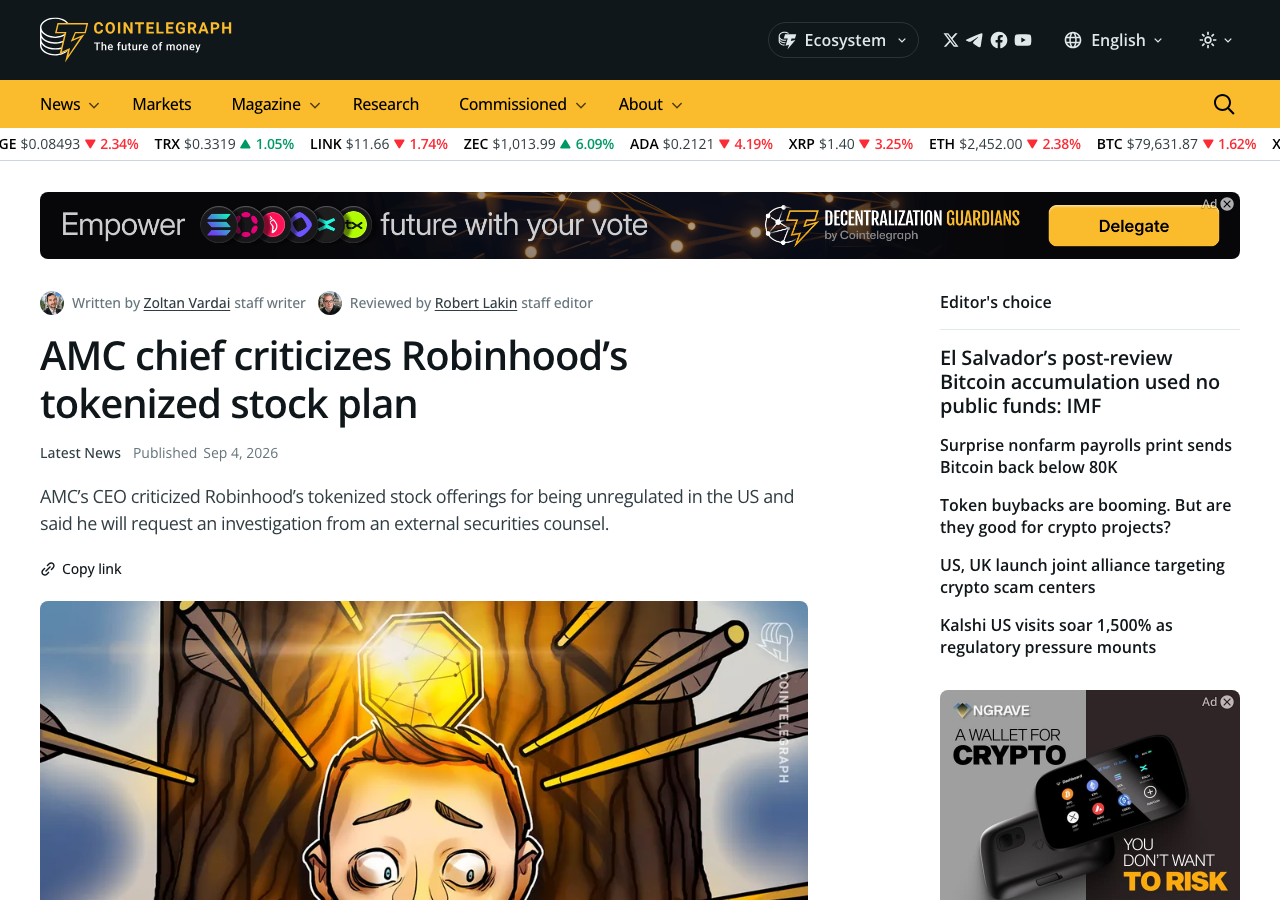
Image Source: Cointelegraph (September 4, 2026)
Structural Consequences of 24-Hour Trading
X user @mkrz_ pointed out an easily overlooked issue: Robinhood Chain enables 24/7 trading of stocks, and this in itself creates new problems.
When the Nasdaq is closed and trading is still happening on-chain, the prices of the stock tokens lose their anchor. According to KuCoin's research, during weekends when demand surged and supply was limited, HIMS stock tokens were once priced 112% higher than their NYSE closing price. On-chain prices and off-chain prices can completely decouple during non-trading hours.
This gap was later expertly exploited by meme traders — that marked the beginning of another story.
Disclaimer: This article represents only the personal views of the author and does not represent the position and views of this platform. This article is for information sharing only and does not constitute any investment advice to anyone. Any disputes between users and authors are unrelated to this platform. If the articles or images on the webpage involve infringement, please provide relevant proof of rights and identity documents and send an email to support@aicoin.com. The relevant staff of this platform will conduct an investigation.